
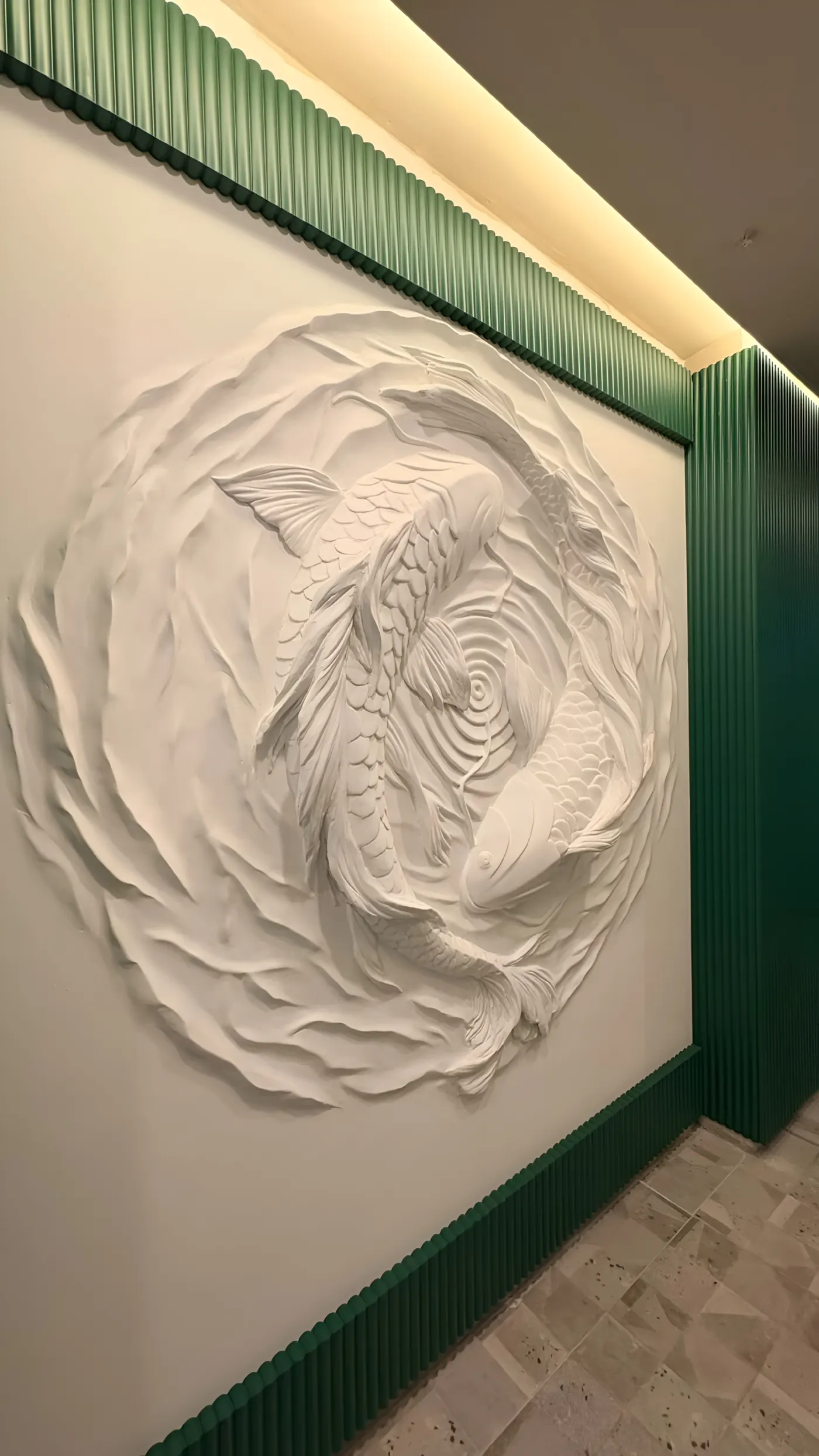
Stand close to a hand-carved relief and you will notice something a photograph rarely shows: no two curves are exactly alike. That small irregularity is not a flaw. It is the reason the surface feels alive.
The hand leaves a record
A moulded panel repeats itself perfectly, and the eye picks up on that repetition quickly, even without knowing why. A carved surface carries the rhythm of the tool and the decisions of the person holding it. Scales on a fish, veins in a leaf, the edge of a wave: each one is shaped individually.
Texture is read through shadow
Relief is a white or single-tone surface, so everything we see comes from shadow. Deeper cuts create strong, dark lines; shallow ones create soft gradients. Balancing the two is most of the craft. Too much depth everywhere looks heavy; too little and the piece disappears once the lights are on.
We don’t carve shapes. We carve the shadows that describe them.
Layers of depth
Most of our pieces work in layers. The main subject sits in high relief and comes towards you. The background stays low and quiet. In the koi above, the fins and tail rise furthest from the wall while the water around them is only suggested. That contrast is what gives the piece movement.

Living with texture
A relief needs very little care. Dust it now and then with a soft, dry brush, keep harsh cleaning products away from the surface, and let the light do the rest. Over the years you will keep noticing new details as the seasons change the way the sun enters the room.